
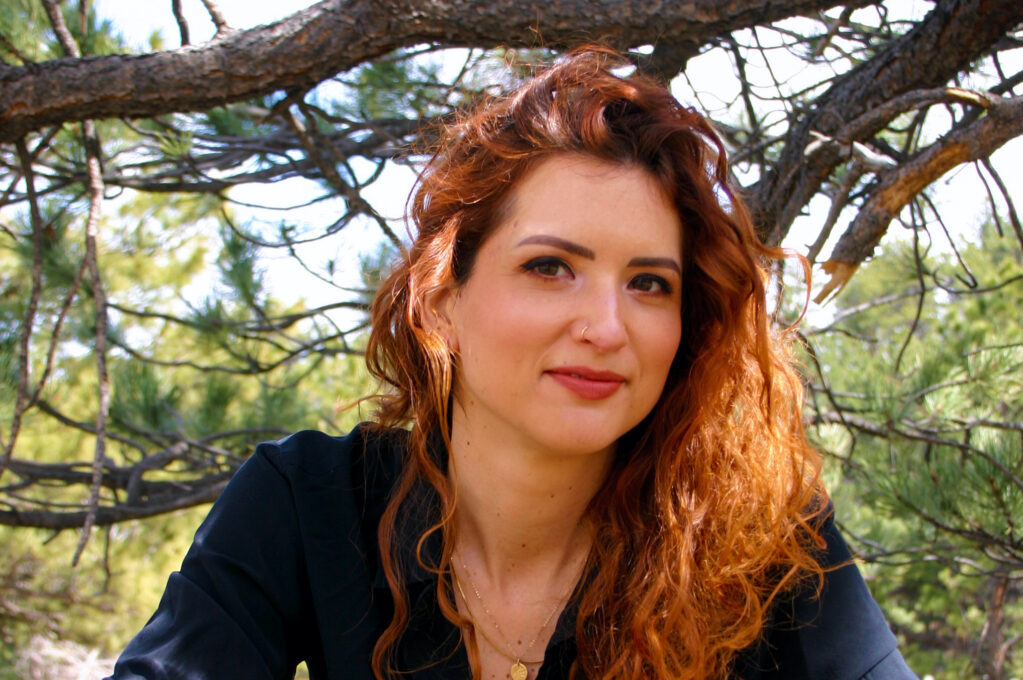
Looking for a new favorite writer? Look no further than Kristina Ten, author of the new collection Tell Me Yours, I’ll Tell You Mine (Stillhouse Press). Longtime readers may remember her from “Keep Tabs on You,” one of our 2020 Best Small Fictions nominees. GennaRose Nethercott describes Tell Me Yours, I’ll Tell You Mine as “a delicious cocktail of nostalgia and dread,” aka the perfect drink for fans of smart, imaginative fiction that straddles the line between darkness and light. As AI strives to wrap its soulless tentacles around the culture, writers like Ten are cherished sentries defending the castle of human creativity.
Pick up your copy of Tell Me Yours, I’ll Tell You Mine here.

Ten shared her thoughts In a recent interview with Cease, Cows.
Chuck Augello: What should readers expect when they open a copy of your collection Tell Me Yours, I’ll Tell You Mine?
Kristina Ten: This is a book for readers who like strange, dark stories that play with expectations around genre, form, and the slippery boundary between the magical and the mundane. Horror mixes with fabulism, mixes with folklore, mixes with sci-fi, and every story revolves around games and game-adjacent rituals. There’s a story about haunted volleyball players, another about dystopian fortune tellers. There’s one about a dangerous summer-camp prank, another about a doomed road trip through space, and another about a mythic creature who gets caught up with exactly the wrong card shark. If you’re into Kelly Link, Carmen Maria Machado, and Kim Fu, I think you might like this one, too.
CA: The opening story, “Keep Tabs on You,” was originally published here at Cease, Cows. I recall reading it in Submittable and immediately thinking, “Yes!” What was the initial spark that set you to writing it?
KT: That’s the very first story I wrote in this collection, before I knew there would be a collection at all. I was working at the Crate & Barrel headquarters outside Chicago at the time, and writing a lot of flash fiction because that’s the kind of thing you can fit into a lunch break at a traditional full-time-in-the-office job like that. They had this huge cafeteria, which is a great place to catch up with coworkers and a terrible place to try to get any writing done. At some point, I discovered that if I took lunch at one of the tiny, perpetually unoccupied tables in the engineering wing, on the opposite side of the building from where I worked, I could have that time all to myself. It was a large organization, and none of the engineers knew who I was. So nobody ever checked on me. Typing away, squinting at the screen, I looked busy enough. And I was.
I wrote “Keep Tabs on You” on one of those lunch breaks. It came to me first as an opening line, which popped into my head unbidden. I had a few different kinds of flat dress-up doll-and-clothing sets growing up, and I especially loved the magnetic ones. But this story’s dolls wanted to be the tabbed paper kind, and who was I to argue?
CA: One of my favorite sentences in the book appears at the opening of “The Curing,” in which you perfectly capture a certain stage of adolescence: “Before everyone scatters on the last day of middle school and emerges from the roiling summer waters fully formed, as theater kids or stoners, or preps, skaters, goths.” A bottle of Elmer’s Glue plays a role in the lives of these young characters. Tell us about the story.
KT: Hey, glad to hear it! There was some talk of that sentence being switched into past tense, since the rest of the story is in past tense. But I pushed for it to stay in present because of exactly what you’re saying: it’s not talking about an era that has passed, but one that every new generation experiences anew. Someone somewhere is always going through it—now, and now, and now.
Anyway, I’d just finished Brenda Peynado’s astonishing Rock Eaters (if you haven’t read it yet, quit reading this and go read that instead). That collection includes stories written from a collective we-without-the-I perspective (think Jeffrey Eugenides’ The Virgin Suicides, too), which I was immediately taken with and knew I had to try. Since then, I’ve heard this point-of-view referred to as both “the Greek chorus” and “fourth person.” Whatever it’s called, I was drawn to what felt like a combination of all the other perspectives’ best qualities: first person’s intimacy, third person’s head-hopping powers, second person’s ability to annoy the hell out of people who don’t get what’s going on and are mad about it…
Too, this collective POV allowed me to create on the page the friend group I wish I had growing up. The bullied and/or disregarded immigrant kids in my school didn’t band together like this, as far as I know. But, man, if we had.
About the glue in particular: True to the games throughline, this book is full of rule makers and rule breakers. I firmly believe that one way to break the rules successfully (that is, without getting caught) is to do things that the people in charge simply haven’t made rules for yet. Here, the kids get away with the glue game because it’s not technically prohibited, and the study-hall monitors don’t technically have a directive to stop them. Let it be a lesson, maybe, to any of us interested in imaginative disobedience.
CA: “ADJECTIVE” is a fascinating, innovative story, a Mad Libs exercise but so much more, touching on themes of immigration. What do you hope readers take from the story?
KT: Mad Libs are interactive: by filling in the blanks, the reader helps direct the story’s progress. At the same time, the reader is bound in by the prompts given, and the more specific the prompts—“occupation (plural),” “type of building”—the more bound in. So while the reader ostensibly has a say in what happens, the degree to which they have a say is limited by existing structures. It felt like a fitting form for a story about agency, perception, and self-definition. The protagonist here is butting up against an external force asserting itself over her: the coworker with loud opinions about who she is and how she should move through the world.
While writing this story, I was thinking about the parenthetical instructions in Carmen Maria Machado’s “The Husband Stitch,” and about second person in general. The recurring complaints I hear from readers who dislike second person are: one, it’s alienating because the “you” isn’t like them at all; and/or two, they feel interrogated, or that the story is making bad assumptions about them. I’m interested in readers’ experience with “ADJECTIVE.” How do they feel being invited to choose, but only within set parameters? What about when those parameters tighten? Do they experience the “you” as themselves or as a character? Do they feel interrogated? Do they balk at the idea of someone who doesn’t know them from Adam making assumptions and declarations about them? Does this make them feel cornered, uncomfortable?
Of course, if you feel cornered reading a book, you can always put that book down. It’s harder when it happens in real life.
CA: How did you approach turning the stories into a collection? Were they written toward a specific theme?
KT: This book was my MFA thesis project. The University of Colorado Boulder has a three-year program—a year longer than is standard in the States, I believe—so by my final year, I’d already finished the manuscript I’d come to grad school to write. Tempting though it was to just submit that manuscript and spend the rest of my time tubing rivers, hiking canyons, and generally indulging in Colorado’s natural splendor, of which there is a lot, I figured that probably wouldn’t be the number-one best use of my time.
So I started a new project. My earlier manuscript was a collection of modern/twisted fairy tales and folktales, and I was still pretty stuck on folklore. So I decided on games and play as the linking force for this new collection, and specifically the strain categorized as “childlore”: folklore learned and passed on to children by other children. Games, pranks, superstitions, riddles, rhymes, songs, divination rituals… I was interested in these traditions’ apparent lightness and lightheartedness, which belied a depth and darkness that I sensed but couldn’t quite put my finger on. It was my thesis year and I was under a deadline. So I had to push onward without having the answers, which deadlines are great for. And which I think is how books ought to be written anyway. I write to try to figure something out. If I already have all the answers, what’s writing the book for?
CA: Tell us about your time at the University of Colorado Boulder MFA program. MFA programs seem to be getting a lot of flak lately. What was your experience?
KT: You’re talking to the wrong person, because unfortunately I’m one of those insufferable types who has always loved school. Love homework. Love book reports (isn’t an author interview a little bit a book report?). Give me a color-coded binder any day. Everything makes sense in a color-coded binder. Everything makes sense if you have rules to follow and the capacity to follow them—until following those rules won’t save you anymore. Which is kind of what this book is about.
Anyway. No, institutions of higher learning, like most institutions, deserve all the scrutiny they get, I think. No argument there. With Boulder, though, I lucked out. The summer I went to Clarion West, Stephen Graham Jones was one of the instructors. That same year, I was bouncing around the prospect of applying to MFA programs, craving a bit more dedicated writing time than the aforementioned office lunch breaks afforded. I’d been cautioned about certain MFA programs’ disinterest in speculative fiction, but when I saw that Stephen—who wrote turn-my-world-upside-down stories that were also werewolf stories—was a professor at CU, I knew CU couldn’t be like that. And I was right. My peers wrote amazingly weird stuff with tons of craft and tons of heart. The atmosphere was supportive rather than competitive, which isn’t really my style. And when I had a story problem, I could go stroll through the Flatirons about it.
CA: What are some of the stories that have inspired you over the years? Is there a “hidden treasure” story that you’d like to recommend?
KT: So many. Kij Johnson’s “In the Mouth of the River of Bees.” Terry Bisson’s “Over Flat Mountain.” Nathan Ballingrud’s “The Visible Filth.” Lesley Nneka Arimah’s “The Future Looks Good.” Charles Yu’s “Standard Loneliness Package.” Gene Wolfe’s “A Fish Story.” Ursula K. Le Guin’s “She Unnames Them.” Vladimir Nabokov’s “Signs and Symbols.” Joyce Carol Oates’ “Take Me, I Am Free.” K-Ming Chang’s “Auntland.” Mariana Enriquez’s “Metamorphosis.” Pam Houston’s “How to Talk to a Hunter.” Karen Russell’s “The Bad Graft.” Aimee Bender’s “The Rememberer.” Etgar Keret’s “Hole in the Wall.” Amal El-Mohtar’s “John Hollowback and the Witch.” Caroline M. Yoachim’s “Welcome to the Medical Clinic at the Interplanetary Relay Station | Hours Since the Last Patient Death: 0.” GennaRose Nethercott’s “Fifty Beasts to Break Your Heart.” Kelly Link’s “The Game of Smash and Recovery.” Everything Lydia Davis. Everything SGJ. Those pocket-size joke books from the Scholastic Book Fair.
I could keep going.
This is hardly “hidden,” but as a treasure I have to mention it, because it hasn’t loosened its grip on me since I first read it: George Saunders’ “The Semplica-Girl Diaries.”
CA: There’s no shortage of ways to spend one’s time. Why do you choose to write fiction?
KT: I’m not being self-deprecating when I say I simply have no other life skills. I can’t tell you what came first: having no other life skills so pursuing writing, or pursuing writing and thus lacking the time and/or brain cells to develop other life skills. I mean, I know plenty of writers who are capable, well-rounded people—I am not one of them. I was recently at a conference and managed to lock myself out of my room on night one, and a fellow writer came to my rescue, in possession of their own toolbox (!) and a truly impressive knowledge of lock picking. Had that wonderful person not come along, my plan A was to sleep on the lawn.
I guess I have a couple other life skills, but they are arguably more time-consuming and even less lucrative than writing. A remarkable accomplishment.
Okay, and writing fiction is the one area of my life in which I’ve felt an intoxicating amount of agency. I can do whatever I want—it’s between me, and that blank document, and whatever gods or house spirits I’m praying to that day to make the words come out. It’s liberating. People will still tell you what you should do, of course, but so far I’ve found it pretty easy to ignore them.
–
Chuck Augello (Contributing Editor) is the author of The Revolving Heart, a Best Books of 2020 selection by Kirkus Reviews. His work has appeared in One Story, SmokeLong Quarterly, Literary Hub, The Coachella Review, and other fine journals. He publishes The Daily Vonnegut, a website exploring the life and art of Kurt Vonnegut. His novel, A Better Heart, was released in November 2021.
Kristina Ten has written about lovers experiencing erosion, demigods attending desert music festivals, spirits lurking in the backs of bathhouses, and seals granting wishes at the bottom of Lake Baikal. Her stories appear in McSweeney’s, Best American Science Fiction and Fantasy, We’re Here: The Best Queer Speculative Fiction, Lightspeed, Nightmare, Uncanny, and elsewhere. She has won the McSweeney’s Stephen Dixon Award, the Subjective Chaos Kind of Award for Short Fiction, and the F(r)iction Writing Contest, and has been a finalist for the Shirley Jackson Award, the Locus Award, and the WSFA Small Press Award. Her debut collection, Tell Me Yours, I’ll Tell You Mine, is forthcoming October 7, 2025 from Stillhouse Press.